Tuesday, February 21, 2012

My Own Dilemma


            Reading the first section of Omnivore’s Dilemma has made me utterly miserable.  All of my food tastes like corn, and my mind is spinning with questions about my personal food morals.  I annoyed my roommate by continuously beginning worried conversations about whether or not capitalism was good or evil all weekend.  I still haven’t figured out a satisfactory answer, but it means that the author is doing his job.
            At first, I thought Michael Pollan was crazy.  Who goes hunting in a forest for their food, and writes 120 pages about corn?  However, as I went on reading I have come to respect his ability as a writer and a researcher.  It would be easy just to present facts about the corn industry and let them sink in, trying to convince the reader just how sad the truth really is.  However, Pollan combines these figures into a story that makes them both more believable and entertaining.  I love that he has this sarcastic sense of humor that is very much in tune with my own.  The way in which he unashamedly calls America the “Republic of Fat” is absolutely wonderful.  It is about time that someone was completely honest with us about the weight problems that face our country, because apparently the statistics are not enough.
            One of the things that most troubled me was that, although I knew America was fat, I hadn’t considered that three in five people are overweight and one in five is obese.  Yet, we are one of the most weight-concerned countries in the world.  Our bookstores are filled with diet plans and self-help books on losing weight.  Is there really that much lack of self-control? 
Before I became a hypocrite, I decided to measure my own BMI and discovered that I would need to gain another 40 lbs. in order to be considered overweight. My family has always followed the “everything in moderation” mantra and all of us are within healthy weights.  We eat cake, cookies, and ice cream, but not entire pails or plates.  I guess the point is that it is possible to survive on the corn diet if you supplement it with a mixture of “real” food as well. 
The second thing that troubled me was the recurring theme of capitalism promoting the unhealthy corn market.  Corn defies the basic laws of macro and microeconomics, which is disconcerting to me as a business major. Wouldn’t it be better for us to allow the free market to find its way back equilibrium?  Is there any way that we can escape from our enslavement to corn?  If we allow the same values to guide us I don’t know if we ever will.  However, it seems like we are trying to drive on a flat tire and eventually the whole mechanism is going to crash.
I’m not sure whether I will soon be able to reconcile my feelings about capitalism and food policy, but I’m glad that this book has made me think.  Of course, everything now tastes a little less flavorful and real, good thing I really like corn.   

Wednesday, February 15, 2012

Rustica pictures (as promised!)

The intense wine list!

Grilled Duck Breast

Bouillabaisse

Seared Salmon and Diver Scallop

Red Velvet Cake

Callebaut Chocolate Brownie (yum!)

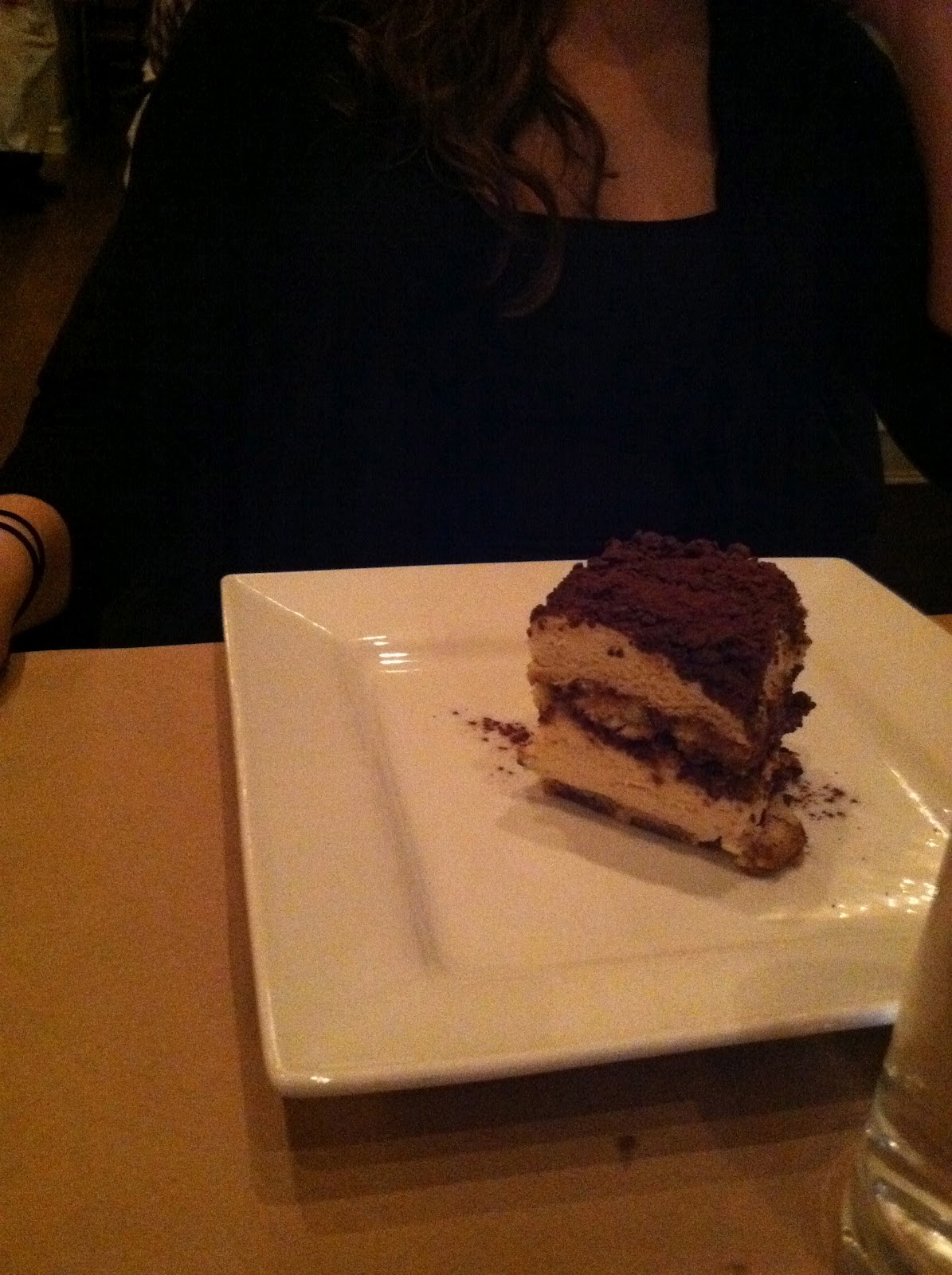
Tiramisu

Tuesday, February 14, 2012

Rustica review


            Rustica introduces itself as home to “Rustic European Cuisine,” citing influences from France, Italy and Spain.  Open only for dinner and located in the Kalamazoo Mall, the small restaurant certainly displays décor relevant to these areas.  The dining area is set up to exude a sense of intimacy, with low lighting, beige walls, and candles on every table.  Quiet, instrumental music plays in the background, making it necessary to talk in hushed voices so as not to be over heard by the next couple sitting only about a foot away. 
The atmosphere is somewhat disrupted by the close quarters in which the tables are squeezed.  It could be due to the large kitchen area that takes up about half of the square-feet.  While it is enticing to be able to watch your food being prepared, it is slightly awkward to be stared at while you eat by the chefs who don’t have anything better to do.  A random bar in the back further confuses the intimate setting.
Generally, Rustica’s fourteen tables are packed, and as they do not take reservations it would be wise to participate in their call-ahead policy, or arrive promptly at 5 pm when they open.  The wait staff is helpful and knowledgeable, especially with regards to the wine list that covers the entire reverse the menu.  The clientele consists primarily of middle-aged, upper-middle class regulars, who the owner sat with in turn, chatting about business and family.  It seemed that these were guests of honor and everyone else were simply guests.  The wait staff also seemed to follow this mantra, why waste time at a table when you know you will get better tips at another?
The menu at Rustica is quite limited, with a number of appetizers but only four pasta dishes and eight main courses.  Appetizers range from about $6, for a bowl of chicken soup, to $13 for the Prince Edward Island Mussels.  The mussels were served in a large crockery dish and are numerous enough to make the price tag seem reasonable.  Each mussel was soft and the sauce that came with it was not enough to overpower the unique taste of the product itself.  Several of them even smelled like the ocean, a sign of their freshness. 
Main courses at Rustica range from $17, for one of the four vegetarian pasta dishes, to $22 for the Seared Salmon and Diver Scallop.  The salmon dish came on a large bed of cannellini beans and a tomato-based sauce.  The salmon was well executed, with a bit of a crunch on the outside and softness on the inside, but the overall flavor was not satisfying.  The whole thing tasted like salt, with no punch of sweetness in the salmon to counter balance.  The amount of beans provided made it seem more like a chili than a fish dish, and it became difficult to stomach all of the starch towards the end.  The scallop that the salmon was paired with had the texture of a big gummy candy and had very little taste, as though it was unseasoned.
One of their well-known dishes, the Grilled Duck Breast, was slightly better.  The duck itself was a bit stringy but full of flavorful fat.  The duck was paired with a helping of barley with pomegranate seeds intermingled.  The pomegranates provided both a pleasing visual contrast and also a burst of freshness to the otherwise heavy meal. 
In terms of price, the desserts are a little more manageable, the majority of them running about $6.  The red velvet cake was presented in a very charming manner, round with little dots of chocolate and vanilla icing on top.  Unfortunately, the icing turned out to be very high in oil content and the cake very low in moisture.  The only saving grace of this dessert were the warm preserved plums that, when eaten with a bite of cake, added the moisture necessary to swallow it down.  A better choice would be the Tiramisu, which had several towering layers of espresso soaked ladyfingers and Kahlua mousse.  The alcohol flavor definitely made a strong appearance, but this could perhaps be positive for those diners under 21. 
The best dessert, and possibly the best dish on the whole menu, is the Callebaut Chocolate Brownie.  Served with a scoop of the “gelato of the day,” the brownie is served warm and presumably only half cooked.  It is more of a half-pudding, half-brownie, with a sweet chocolate ganache seeping into the fresh brownie.  This is a must have dish at Rustica and not one likely to be shared once it’s tasted. 
Overall, this is not a place for college students who are looking for a good deal.  A meal for two can easily run about $80, including tip, and the quality is not enough to justify the expense.  Perhaps paired with one of Rustica’s 180 wine choices, the entrees would take on a new meaning and the experience would have greater depth, but that time is not now.  Kalamazoo College students would be better off going to Olive Garden, filling up on breadsticks and salad and talking loudly for under $20.

*There are pictures to come, I promise!*

Thursday, February 9, 2012

Pre-Rustica


My roommate, Hannah, has been raving about Rustica ever since I arrived here in Kalamazoo freshman year.  She talks about the duck, the bread, and the desserts in such loving terms that I have always wanted to go, to test out her claims.  I always intended to go with my parents, so that they would pay, but never had the occasion or time when they visited.  Tomorrow night I will finally be going, and I am excited!
            On the website, Rustica identifies itself as a restaurant serving “Rustic European Cuisine.”  Too bad there are so many countries in Europe with so many different food cultures, so what area is this food representing?  Digging in further, “Rustica blends influences from France, Italy, Spain and other European countries with regional Michigan fare.”  This sounds very much like Americanized-authentic, which makes me excited.  Rustica also uses as much local produce and meats as possible, which I am in full support of.
            Moving onto the online menu, I begin to be a little hesitant.  The appetizer section presents dishes like mussels and scallops at prices I would normally pay for a full meal at Panera, but oh well.  Not being a big meat eater, the sight of main dishes with names like “Grilled Duck Breast” and “Braised Lamb Shank” have me cringing.  However, as this is supposed to be a crossing into a totally new experience, I will force myself to try out one of these meat dishes as my main course, maybe even the “Grilled Hanger Steak!”  Getting to the desserts, names like tiramisu, red velvet cake, and chocolate éclair make my mouth water.  I will definitely be writing a full section on these delectable.  Maybe not, but you can bet I will try at least two!
            Food aside, I am a little nervous that it will be weird for me to write during the dining experience, especially since I am going with a friend.  I worry that the review might take away from the full dining experience, so I will do my best to stay focused but also write as many notes as possible.  I’m so glad to have my iPhone at instances like this so I can type and take pictures all on one device, hopefully I will be less conspicuous that way.  I’m severely disappointed that I can not give you all a good review of the wine list, but I don’t think anyone believes I’m 21.
            Overall, I am so excited for this new experience and a reason to try out this restaurant!  I hope all of you have great success with your dining experiences as well.  Can’t wait to read them all. 

Monday, February 6, 2012

Emma's Kitchen (revised)

          Light streams in through several thick glass windows, spilling onto the blue linoleum and the white countertops.  A metal coffee maker steeps on the gas stove, blue flames playing around the bottom.  The fridge is cluttered with photos of a blond girl with piercing blue eyes and her younger brother in different states of childhood.  In several pictures, the blond girl stands arm in arm with another girl her age with frizzy, dirty blonde hair and round glasses.  An open cupboard displays a multitude of mismatched dishes, neatly stacked.  The oven is propped open, warming the room with the heat and tantalizing aroma of just baked goodies.
Sitting on a newly upholstered chair at the raised, wood breakfast bar, I pick at the homemade blueberry muffin in front of me.  The blueberries are flavorful and the pastry is light and delicious, but my appetite is gone.  It’s been almost two months since I heard the news about Emma, but being in her kitchen is still hard.  The seizure that took her life was so unexpected that it could almost be a dream, even now.  I look across the table and smile at Emma’s mother, Rebecca, and take a bite of the muffin she made just for me.
            “These are so much better than those gross Jiffy muffins you used to make with Emma, right?” she says to me, chuckling.  I agree whole-heartedly and take another bite.
            “Those were nasty!” I say, laughing, “But Emma loved them for some reason!”
            “It was the novelty, she was in love with the idea that you could make muffins for 33 cents.”
            I have to agree, although I did appreciate those muffins, they were one of the few things I could claim to have introduced to Emma over the course of our thirteen year friendship.  Emma fell in love with their fluffy texture, their miniature artificial blueberry specks, and probably the fact that it irked her mother so.  Every time we planned a sleepover, she would beg me to bring these muffins to her house, although I grew increasingly terrified when I found out how much her mother detested them.  It was almost like I was a spy with a special mission to sneak them into the house undetected.  
            “Let’s make muffins!” Emma would shout as soon as my eyes opened in the morning.  She grabbed the box and raced downstairs to prepare the muffin pan.  We would grab a bowl, add the one egg and half cup of water, and stir vigorously, thinking how clever we were to make them taste so good.  Twenty minutes later we were munching on golden brown muffins and her mother was telling us how gross and artificial they were, a fact that escaped me for many long years. 

            It was a relief to be eating these freshly made muffins; it meant that people had finally stopped bringing food to the house.  At first it seemed as if they hoped their store-bought chocolate cherry bread would heal the wounds of a child’s death, an idea that made me furious.  No amount of food could ever replace the love that Emma had given to so many people, I thought. 
In the earliest days, after the news hit, the counters were so cluttered with pies, dinners, cookies, and bread that there was no place to sit and eat.  A room that was already full of grief now had to house a multitude of food that Emma’s family probably never had the stomach to eat.  Slowly, as the amount of food dwindled, so did my anger.  I realized that these people brought food not because they thought it would make things better, but because food is our connection to life.  So many memories are wrapped up in food, and bringing homemade dishes is a symbol that there is still hope, and there is still life after a tragedy like this.
           
            Sipping the dark espresso roast in my mug, I see a small, green frog sitting patiently at the bottom of my cup.  Two of the coffee mugs in the house have little animals in the bottom, a treat after finishing your cup of coffee or hot chocolate.  Often times, I would barely taste the drink in my rush to get to the cute little frog that was waiting for me.  Sometimes Emma and I would even make it a race, if we were feeling competitive and didn’t mind burning our tongues.  Rebecca reaches across the table and touches my hand.
            “My favorite memory of you and Emma is when you would play imaginary games together for hours.  It was amazing.”  She laughs and I roll my eyes, giggling.  This was one of the many embarrassing stories about my childhood that had come out after Emma’s passing.  I endured these stories with good humor, happy to have a reason to be recognized as important in Emma’s life.  Our favorite characters were from Harry Potter, but when the Lord of the Rings movies came out, Emma and I pretended that the triangles of tortillas with cheese we had learned to make were the lembas bread that Frodo and Sam ate on their treacherous journey to Mordor.  Of course, stale Elven bread was probably nothing compared to the chewy goodness of white corn tortillas and sharp cheddar.
           
            I stood and stretched, glancing around the room once more.  Everything at Emma’s house had always been more exciting, artistic and unique.  Two months ago, all the things, all the food that reminded me of her became things that I couldn’t eat or be around.  Now, as I looked down at the remains of my muffin, I grinned.  Emma would smile to see me eating breakfast with her mother, discussing our lives and how much we miss her.  I hug Rebecca and step out of the creaky side door, saying, "I love you."  Even though Emma might be gone, this kitchen is somewhere I will always be treated as family, somewhere I can feel close to her through the simplest things, like eating a blueberry muffin.

**I promise this a real conversation that I had with Rebecca this weekend.  Life is so coincidental sometimes, glad I procrastinated in my revisions for once!**

Wednesday, February 1, 2012

Secrets of the Grocery Store


            Let me just say, I was so happy to come across dear old Tony in this set of readings.  I found myself becoming increasingly depressed as I read through tales of overwhelming gluttony at the beefsteak, loss of a friend, and then the disappearance of innovation in French cuisine.  Although these were very interesting pieces, I despaired about what I would do when it came time to write my blog.  Needless to say, it was nice to come across Do Not Eat Before Reading This. 
            Working in any type of service industry, you get to know the deep dark secrets of how the business runs.  For me, I found Bourdain’s expose on kitchen life to be very relatable to my years long experience at a grocery store.  Although the store I worked at was not a chain, there was still a lot of money saving tricks that we used that our customers probably didn’t even think about.  Not to mention that the workers had very different personalities then the ones they portrayed on the outside.
            We had nicknames for some of our favorite and least favorite customers, and sometimes we even went out of our way to avoid some of them.  “Dog lady” would always come in wanting a carryout for her groceries, even though she was quite able-bodied, so the stockers would immediately go on break whenever she arrived.  My managers would let me take a break whenever an elderly man, who had taken a creepy liking to me, would make his daily shopping trip.  That was mean, but not as mean as some of my fellow cashiers bagging eggs under cans for the customers who were really rude to them.  This seemed to go along well with Bourdain’s disdain for the “well-done” people.
            Customers also didn’t know that when they brought a bruised or moldy piece of fruit to our attention the bad spots were just cut out and it was thrown into a fruit salad.  The same customer would probably end up buying it the next day.  They also probably wouldn’t have liked that we used flour and sugar bags that were about to expire in our bakery to make their donuts and cakes.  Then there was the hot food area where the workers were instructed to tell customers that the chicken was fresh out of the fryer, even when it was a few hours old.  Most of them never knew the difference, so I guess it didn’t hurt.
            Honestly, when Bourdain talks about all of the ungloved hands and the reused bread, it doesn’t bother me.  These are practices that reduce waste, and that’s a good thing in my opinion.  In a business, especially a small one, you can’t afford to be completely septic or you would go broke.  I would be happy to know that if I didn’t finish my breadsticks at Olive Garden that they would reheat them and present them as fresh to another table.  Maybe then I wouldn’t feel guilty about being wasteful and take them home to eat as a late night snack.